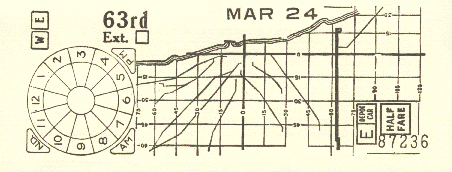
Beginning in 1932, the typical CSL transfer had a "clock" at the top where the time of issuance was punched, and a map of Chicago where the boarding location was punched. The date was printed on the transfer, and the route of issue was indicated and was highlighted on the map. At transfer points, the location would be punched on the map on the transfer. This basic transfer design remained in use until 1986.
This transfer actually is a reprint, as part of a promotion by a Chicago area bank during the 1970's.
Until 1974, the basic transfer had a map with grid lines 15 standard blocks apart. (16 blocks equals 2 miles.) With these transfers, ten minutes travel time was allowed for each 15 block zone, with additional time allowed through the congested downtown area, and allowances for waiting for connecting streetcars or buses.
Transfers issued only when fare is paid and valid only for continuous rides over reasonably direct routes allowing for the time necessary to change cars at transfer points.
Transfers accepted only at points of crossing, convergence, divergence or extension with line last used and valid only when presented by or for person to or for whom issued.
Reverse riding will be subject to the questioning of the conductor.
Clock indicates time of leaving zone in which transfer was issued.
Travelling time is checked by zones from transfer point back to starting zone. 10 minutes per zone is considered the standard time.
Passengers should check the marking of transfers after each presentation.
PENALTY FOR FRAUDULENT USE
It is a misdemeanor, punishable by FINE of not to exceed $25.00 for any person:
(1) To sell, exchange or give away this transfer.
(2) To throw away this transfer, without first tearing same in two.
(3) To offer this transfer for passage, unless received from an agent of the Company by or for the use of person offering same.
(4) To use this transfer for stop-over purposes.
(See Unification Ordinance passes November 13, 1913.)