Because the Loop elevated stations were constructed directly above the streets, there was not always room for a "mezzanine" level station entrance. A mezzanine level would enable a single entrance to handle access to both platforms, and allow for transferring between the platforms. At some elevated stations, passenger bridges were eventually constructed above the tracks to enable free transferring.
After the two subway lines were constructed, various provisions have been used to enable free transfers downtown involving those lines. The two subway lines parallel each other through downtown, one block apart. And at a deeper level below Washington St. and below Jackson Blvd., passenger transfer tunnels were constructed between the two subway lines. Although a construction project eliminated the tunnel at Washington St.
For transferring between the subway and Loop elevated lines, agents issued special free paper transfers to passengers exiting designated stations, and the transfers would be accepted at a designated station upstairs or downstairs. Those transfers were eliminated in 1981, and it became necessary to use regular transfers to change between elevated and subway trains.
In 1991, the Clark/Lake elevated and subway stations were rebuilt into a new combined station, constructed within the new James Thompson State of Illinois Building, and in the 203 North La Salle building on the opposite side of Lake Street. Passengers entering the rapid transit station there would proceed through the turnstiles, and then go either upstairs to the elevated lines, or downstairs to the Blue Line subway. Passengers could thus transfer between the elevated and subway lines without needing to pass through any turnstiles.
In 2002, a new transfer passageway opened at Roosevelt Road, between the Red Line subway and the Green Line and Orange Line elevated line, enabling free transferring.
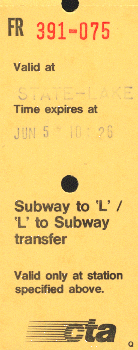
In 1993, free paper transfers were resurrected at State/Lake between the elevated lines and the Red Line subway. This coincided with the "flip flop" of he two south side lines, and enabled passengers used to not paying for transfers to continue to not pay. Actually, the transfers were made of cardboard, and were originally dispensed by designated exit turnstiles at those elevated and subway stations. The exit turnstiles were later replaced with machines which would dispense transfers at the push of a button. However, this system was not compatible with the CTA's new automatic fare collection system with Transit Cards, so it was eliminated in 1999. Now, if one does not already have a Transit Card or pass, one must purchase a Transit Card from a vending machine at the station. But at State/Lake, a Transit Card now makes this change of trains possible, without incurring the cost of a transfer or the use of a ride. A Transit Card normally allows a second and a third ride for transferring. But the equipment at these stations is programmed, so that transferring between trains does not count against the three ride limit. In 2006, coinciding with the introduction of the Pink Line, this feature was added to the Jackson subway stations and the State/Van Buren elevated station.